


What to Do If Your Engine Overheats: A Step-by-Step Guide for New Mexico Drivers
November 5, 2026
Heater Blowing Cold? Thermostat, Coolant, and Heater Core Clues
November 7, 2026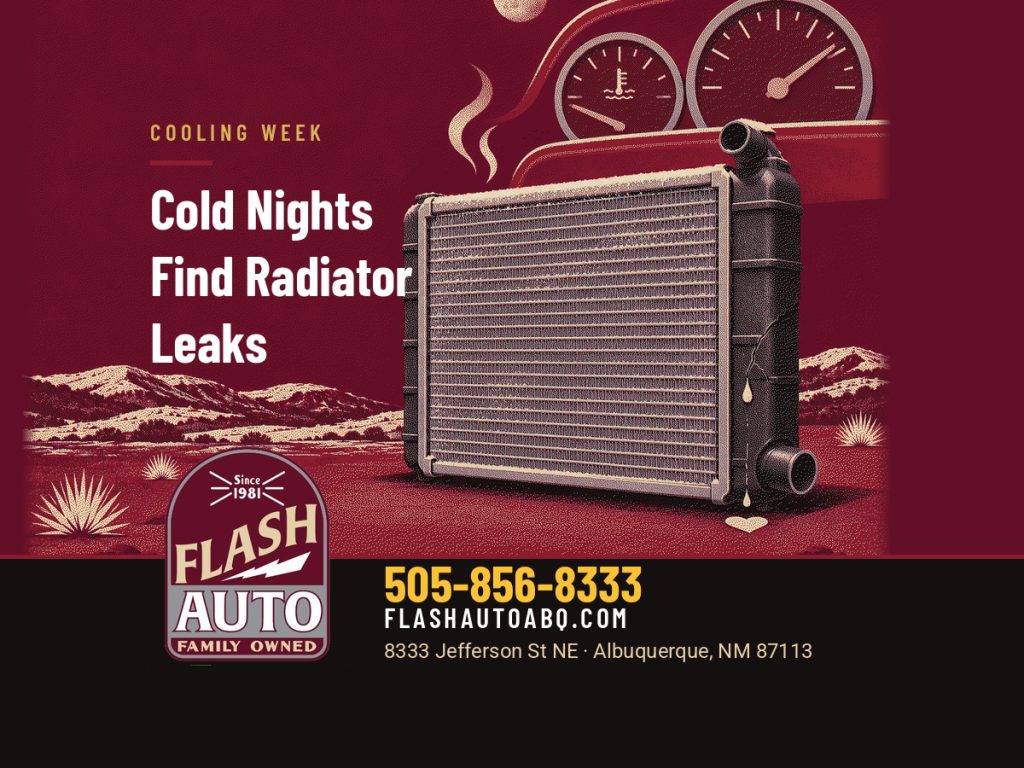
A small colored puddle under the front bumper on a chilly November morning is easy to shrug off. But a radiator leak that shows up when the weather turns cold usually started months ago, and it rarely fixes itself. Here is why cold weather exposes radiator leaks, the signs to watch for, and how a pressure test finds the leak before it strands you.
- Many radiators pair an aluminum core with plastic end tanks, and years of high desert heat age the plastic and seals
- Cold weather makes parts contract, opening hairline cracks and tired seams that held all summer
- A cooling system pressure test can find a leak before it turns into steam on the shoulder of I-25
Why Do Radiator Leaks Show Up in November?
Aluminum cores, plastic tanks
Many modern radiators use an aluminum core, where coolant gives up its heat, joined to plastic tanks on each side. The tanks are crimped to the core with a gasket sealing the seam. The plastic and the gasket are the parts that age.
High desert heat cycles take a toll
Every drive heats the cooling system, and every cool-down lets it contract. Albuquerque adds hot summers, intense sun, and big day-to-night temperature swings. Over years of those cycles, plastic tanks can grow brittle and seam gaskets can harden.
Cold contraction opens the gaps
Aluminum and plastic do not shrink at the same rate when the temperature drops. A seam that sealed fine in July can start weeping on a cold morning. A hairline crack that stayed tight in warm weather can open just enough to drip.
That is why so many radiator leaks seem to appear out of nowhere in November. The damage built up over the summer; the cold simply revealed it.
Weak coolant adds to the stress. Coolant expands when it freezes, and a mix with too much water can turn to slush in a hard freeze and block circulation.
Signs of a Radiator Leak
Watch for any of these, especially after the first cold nights:
- A colored puddle under the front bumper. Coolant comes in green, orange, pink, yellow, and blue. Clear water dripping near the passenger footwell after running the A/C is usually just condensation.
- Crusty residue along the tank seams. Dried coolant leaves a white, green, or pink crust where it has been seeping.
- A coolant reservoir that keeps dropping below the mark
- A sweet smell around the front of the vehicle, or in the cab with the heat on
- Steam from under the hood after a drive
- A temperature gauge that runs higher than usual
Do Not Forget the Radiator Cap
The radiator cap is more than a lid. It holds the cooling system at pressure, which raises the boiling point of the coolant. A worn cap seal can let coolant escape as vapor or let the system lose pressure.
A failing cap can cause coolant loss and overheating even when the radiator itself is sound. It gets tested along with the rest of the system.
Never open a radiator cap on a hot engine. Hot coolant under pressure can spray out and cause serious burns.
Spotted a puddle on the driveway? A cooling system pressure test at Flash Auto can find the source.
How a Cooling System Pressure Test Finds Leaks
A pressure test recreates the conditions your cooling system sees on the road, with the engine cool and safe to work on. A technician attaches a tester to the radiator or reservoir neck and pumps the system to its rated pressure.
Then it is a matter of watching and looking:
- If the gauge drops, coolant is escaping somewhere
- Under pressure, slow seeps often turn into visible drips
- The cap gets its own test on an adapter to confirm it holds pressure
NHTSA’s winter driving tips recommend checking the cooling system for leaks and testing the coolant before winter. Once the leak is found, Flash Auto will talk with you about repair options, with your go-ahead before any work begins.
Is Radiator Stop-Leak a Good Idea?
Stop-leak products contain particles meant to plug small leaks from the inside. In an emergency, one may get you home. As a fix, it has real drawbacks:
- The same particles can clog small passages in the radiator and heater core
- A partial plug can hide the leak for a while, then fail without warning
- It can make the original leak harder to find later
Treat stop-leak as a short-term patch, not a repair. Check your owner’s manual before adding anything to the cooling system, and have the leak found soon.
Radiator Leak Signs and What They Mean
| Sign | Likely Source | What to Do | If You Wait |
|---|---|---|---|
| Colored puddle under the front bumper | Radiator tank, seam, or lower hose | Pressure test to find the leak | Low coolant, overheating |
| Crusty residue on tank seams | Slow seep at a tank gasket | Inspect and pressure test | Seep becomes a steady leak |
| Reservoir keeps dropping, no puddle | Cap, small seep that evaporates, or internal leak | Pressure test, cap test | Overheating without warning |
| Sweet smell with the heat on | Heater core or hose leak | Inspect soon | Windshield fog, coolant loss |
| Steam after a drive | Active leak onto hot parts | Pull over, engine off, let it cool | Engine damage |
| Gauge running higher than usual | Coolant loss or blocked radiator | Check the level cold, inspect | Overheating on a climb |
HD Diesel Radiators and Stacked Coolers
Heavy-duty diesel pickups, including Power Stroke, Cummins, and Duramax trucks, carry several heat exchangers stacked in front of the engine. Depending on the truck, that can include the radiator, the intercooler, the transmission cooler, and the A/C condenser.
That stack makes leaks harder to spot. Coolant can drip from a radiator seam and land somewhere unexpected, and dust and bugs packed between the layers can hide a seep. HD diesel pickups are a Flash Auto specialty, so a careful inspection of the whole stack is part of finding the source.
What to Do If You Spot a Leak Today
- Check the coolant reservoir with the engine cold.
- Top off with the coolant type your owner’s manual specifies.
- Watch the temperature gauge on every drive until the leak is found.
- If the gauge climbs, pull over safely and follow “What to Do If Your Engine Overheats: A Step-by-Step Guide for New Mexico Drivers.”
For a full look at hoses, belts, and coolant, see our cooling system fall check.
Frequently Asked Questions
How do I know if my radiator is leaking?
Common signs include a colored puddle under the front bumper, crusty residue along the radiator tank seams, a coolant reservoir that keeps dropping, a sweet smell, and a temperature gauge running higher than usual. A cooling system pressure test confirms the leak and pinpoints where it is.
Can a bad radiator cap cause coolant loss?
Yes. The radiator cap holds the cooling system at pressure. A worn seal can let coolant escape as vapor, often with no puddle, and can lead to overheating. The cap can be pressure tested on its own.
Is it safe to use radiator stop-leak?
Stop-leak can be a short-term emergency patch, but it is not a repair. Its particles can clog small passages in the radiator and heater core and can make the real leak harder to find. Check your owner’s manual and have the leak located soon.
Find the Leak Before Winter Finds It for You
A small radiator leak in November can become steam on the shoulder in January. A pressure test now turns a mystery puddle into a clear answer.
Flash Auto has been family owned since 1981 and is a AAA Approved Repair Facility. You get straight answers and your go-ahead before any work begins. Call 505-856-8333 or book your visit online. We are on Jefferson St NE, near the North I-25 corridor.
Flash Auto
8333 Jefferson St NE
Albuquerque, NM 87113
505-856-8333