Wipers, Lights, and Shorter Days: The Visibility Trio to Fix Before the Time Change
October 7, 2026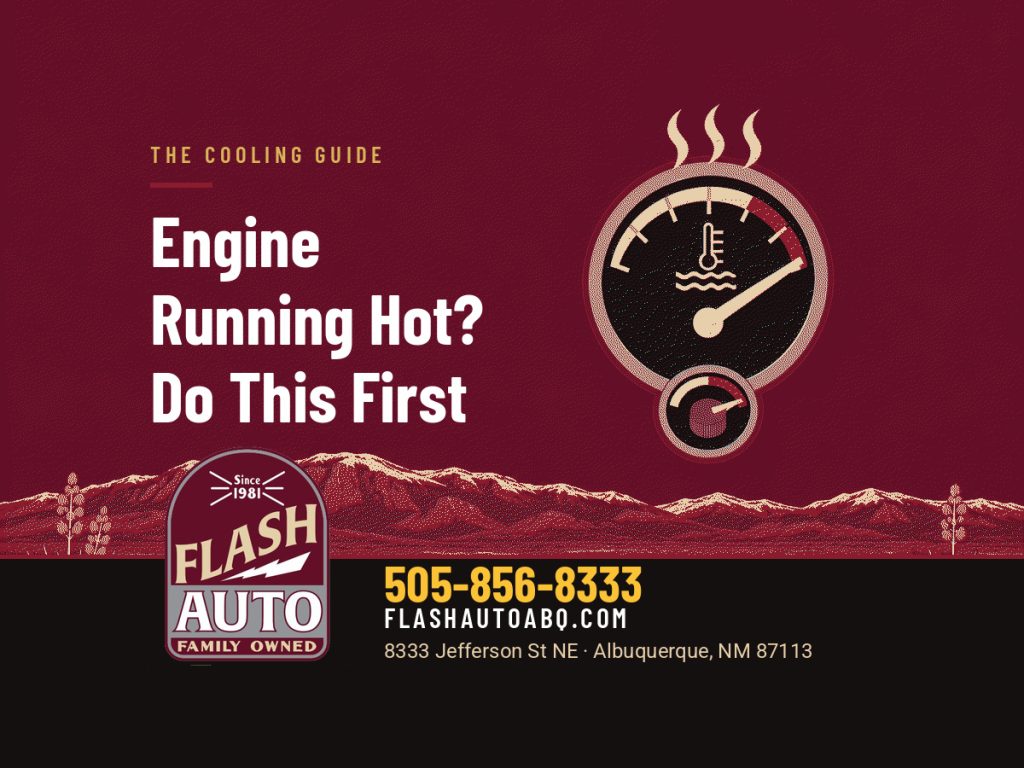
The temperature gauge starts climbing on I-25, steam curls out from under the hood, and you have about a minute to make good decisions. What you do next can be the difference between a cooled-down engine and a seriously damaged one. This guide covers the warning signs, the first 60 seconds, pulling over safely, and what to check once the engine cools.
- Turning off the A/C and turning the heat on full pulls heat away from the engine while you find a safe place to stop
- Never open a hot radiator cap, and give the engine at least 15 minutes to cool before you check or add coolant
- Most overheating traces back to a few causes, from a slow leak to a stuck thermostat, and most give warning first
How Do You Know Your Engine Is Overheating?
Watch for these warning signs:
- The temperature gauge climbing toward red, or past where it normally sits
- A warning light or message on the dash
- Steam or vapor rising from under the hood
- A sweet smell from hot coolant
- Reduced power, since some vehicles limit output to protect the engine
The First 60 Seconds: A/C Off, Heat On
AAA’s first step is to pull over as soon as you can. If you cannot stop right away, turn off the A/C and turn on the heat. The A/C adds load to the engine, while the heater pulls hot coolant through the heater core, a small radiator behind the dashboard.
Set the heat to its hottest setting with the fan on high, and ease off the throttle. It feels backward, but it buys time.
How to Pull Over Safely on I-25 or I-40
Exit or shoulder?
If an exit is close and the gauge has not reached red, take it and stop in a parking lot, away from interstate traffic.
If steam is pouring out, the gauge is pegged, or a message tells you to stop, pull onto the right shoulder now, as far from the travel lanes as you safely can.
Once you are stopped
- Turn on your hazard lights and shut the engine off
- Set out flares or reflectors if you can do it safely
- On a busy shoulder, wait inside with your seat belt on unless you see smoke or flames
AAA also suggests raising the hood, which signals that you need help and lets heat escape. Wait until any steam stops before you lift it, and stay well clear of traffic.
Never Open a Hot Radiator Cap
A hot cooling system is under pressure. Removing a hot radiator cap or pressurized reservoir cap can spray scalding coolant and cause serious injury. Do not loosen it “just a little” to check.
AAA’s guidance is to wait at least 15 minutes for the radiator to cool before adding water or coolant.
How to check coolant once the engine is cool
- Look at the overflow reservoir first; it has cold and hot level marks.
- If it is empty or very low, look under the vehicle for a puddle.
- Open the cap slowly with a rag over it, as your owner’s manual directs.
- Add the coolant your manual specifies, or water in an emergency, to the marked level.
Plain water thins freeze and corrosion protection, so have the mix tested soon as November nights turn cold.
Should You Keep Driving or Call for Help?
A short, careful drive may be reasonable if the gauge returned to normal, you added coolant, there is no active leak, and a safe destination is nearby.
Call for help instead if coolant is pouring out, the gauge climbs again within minutes, you hear knocking, an oil pressure warning comes on, or steam keeps rising after shutdown. Pushing an overheating engine can turn a small problem into a major one.
Gauge creeping up on your commute? A cooling system inspection at Flash Auto can find the cause before it leaves you on the shoulder.
What Not to Do When Your Engine Overheats
- Do not keep driving in the red. Heat can warp metal parts and damage the head gasket.
- Do not pour cold water on a hot engine. A sudden temperature shock can crack hot metal.
- Do not ignore it once it cools. Overheating has a cause, and it usually returns.
What Causes an Engine to Overheat?
Low coolant or a leak
Leaks can start at hoses, the radiator, the water pump, or the heater core.
A thermostat stuck closed
If the thermostat sticks shut, coolant stays trapped in the engine instead of reaching the radiator, and temperatures climb fast.
A failing water pump or slipping belt
The pump circulates coolant, and on many engines a belt drives it. A worn pump or a slipping or broken belt slows or stops the flow.
Cooling fan or fan clutch
At idle and low speed, the radiator depends on the fan. Overheating in traffic that clears up at highway speed points here.
A clogged radiator
Dust, bugs, and debris pack the outside fins, while scale and old coolant block passages inside.
A head gasket problem
A failing head gasket can push combustion gases into the coolant or let coolant leak internally. White exhaust smoke and unexplained coolant loss are clues.
Overheating Symptoms and What to Do
| Symptom | Likely Cause | What to Do | If You Wait |
|---|---|---|---|
| Gauge climbs in traffic, normal on the highway | Fan or fan clutch | Cooling system inspection | Overheating in every slowdown |
| Gauge climbs fast after startup | Stuck thermostat or very low coolant | Stop, cool, check coolant | Rapid overheating |
| Puddle under the front, sweet smell | Coolant leak | Pressure test to find the leak | Running low without warning |
| Steam from under the hood | Major leak or boiling coolant | Pull over, engine off, wait | Serious engine damage |
| Squeal, then a rising gauge | Slipping or broken belt | Stop driving, inspect | Overheating, no charging |
| White exhaust smoke, coolant loss | Possible head gasket issue | Diagnosis soon | Severe internal damage |
A Cooling Emergency Kit for the Trunk
- A jug of the correct premixed coolant, plus a gallon of water
- Work gloves, an old towel, a flashlight, reflectors, and a phone charger
- Your owner’s manual and roadside assistance number
Overheating Notes for HD Diesel Pickup Owners
Heavy-duty diesel pickups, including Power Stroke, Cummins, and Duramax trucks, work their cooling systems hardest on long climbs with a full bed or a trailer behind. Many show transmission temperature as well as coolant temperature, so watch both.
If either gauge rises on a grade like La Bajada or Tijeras Canyon, back off the throttle and downshift or use tow/haul mode. HD diesel pickups are a Flash Auto specialty, so bring your cooling questions with you.
Overheating Is Not Only a Summer Problem
Cold weather brings its own cooling troubles, from leaks that open as parts contract to coolant mixes too weak for a freezing night. Our December post, “Can an Engine Overheat in Winter? Five Cold-Weather Causes,” covers them. For hoses, belts, and the radiator, read our cooling system fall check.
Frequently Asked Questions
Why should I turn the heater on when my engine overheats?
The heater core works like a small extra radiator. Running the heat on high pulls hot coolant through it and moves some engine heat into the cab. AAA recommends it if you cannot pull over immediately.
How long should I wait before checking coolant on an overheated engine?
Wait at least 15 minutes, as AAA advises, and longer if the engine still feels hot. Never remove a hot radiator cap or reservoir cap, because pressurized coolant can spray out and cause serious burns.
Can I drive my car after it overheats?
Sometimes, for a short distance, if the gauge returns to normal, the coolant is topped off, and there is no active leak. If the gauge climbs again, stop and call for help. Either way, have the cooling system inspected soon.
Find the Cause Before It Finds You Again
An overheat is a warning, not a one-time event. A cooling system inspection finds the cause before the next long climb or cold snap.
Flash Auto has been family owned since 1981 and is a AAA Approved Repair Facility. We will inspect and test the system, find the cause, and talk with you about repair options, with your go-ahead before any work begins. Call 505-856-8333 or book your visit online. Flash Auto is on Jefferson St NE, near the North I-25 corridor.
Flash Auto
8333 Jefferson St NE
Albuquerque, NM 87113
505-856-8333